


Business Use Cases for AI Agents: Automation, Decision-Making, and ROI
For the past five years, enterprise AI conversations centered on chatbots, content generators, and copilot tools — assistants that respond to human prompts but require constant direction. In 2025 and into 2026, the paradigm is shifting toward agentic AI: systems that perceive goals, plan multi-step strategies, execute actions across tools and services, and iteratively improve — all with minimal human intervention.
Understanding the Autonomy Ladder
Analogous to the SAE's five levels of vehicle autonomy, AI systems can be rated by how independently they operate:
- Level 1 — Assisted: AI provides suggestions that humans execute (copilots, autocomplete)
- Level 2 — Partial Automation: AI handles specific subtasks with human oversight (summarization, classification)
- Level 3 — Conditional Automation: AI manages complete workflows in defined contexts, escalates edge cases
- Level 4 — High Automation: AI operates across entire processes with minimal human checkpoints
- Level 5 — Full Autonomy: AI sets and executes its own sub-goals to achieve a broader objective with human approval only at key milestones
While Level 5 remains aspirational for most enterprise contexts, Level 3 and Level 4 systems are production-ready today and are already transforming sectors from e-commerce to financial services.
What Makes an AI Agent Different from a Chatbot?
Traditional conversational AI (like early ChatGPT interfaces) operates on a single-turn or short-session basis — you ask, it answers. Agents are architecturally different in three key ways:
1. Tool Use and Orchestration
Agents can invoke external tools — APIs, databases, code interpreters, web browsers, file systems — as part of their reasoning process. A customer service agent, for example, can simultaneously query your CRM, check inventory, calculate shipping options, and draft a personalized resolution email in a single interaction.
2. Memory and State Persistence
Unlike stateless chatbots that forget each session, agents maintain working memory across interactions. Enterprise agent frameworks like LangGraph, AutoGen, and CrewAI support long-term memory stores that let agents build context over weeks or months of operation — learning patterns, user preferences, and domain-specific nuances.
3. Goal Decomposition and Replanning
Given a high-level objective ("increase lead qualification rate by 20% this quarter"), an advanced agent can decompose this into a sequence of sub-goals, assign them to specialized sub-agents, monitor execution, and replan when obstacles are encountered — without waiting for human micro-management.
Practical Business Applications Available Today
Sales and Lead Qualification
Agentic SDR (Sales Development Representative) systems can autonomously research inbound leads, score them against your ICP (Ideal Customer Profile), enrich records from LinkedIn and firmographic databases, draft personalized outreach emails, and schedule calendar invites — all within minutes of a form submission.
Content Operations
Content production pipelines are being fully agentified: brief generation from keyword data, draft writing, fact-checking against trusted sources, SEO optimization, image sourcing, CMS publication, and performance monitoring — a workflow that previously required a team of three can be managed by a single human editor overseeing an agent pipeline.
Financial Reporting and Analysis
Agents connected to financial data sources can generate weekly P&L commentary, flag anomalies in expense categories, model forecast scenarios, and deliver executive summaries to Slack or email — tasks that traditionally consumed 15-20 hours of analyst time per week.
Customer Support Escalation
Level 3-4 support agents handle Tier 1 and Tier 2 queries autonomously, route complex technical issues to the right specialist, follow up on unresolved tickets, and proactively identify customers showing churn signals — continuously improving from resolved case histories.
The Architecture of Enterprise-Grade Agent Systems
Building reliable, auditable agent systems for enterprise use requires more than connecting an LLM to a few APIs. Production-ready architectures include:
- Tool manifest and permission model: Define exactly which tools each agent can access and under what conditions
- Guardrails and policy enforcement: Input and output filters that prevent agents from taking unauthorized actions
- Observability and audit trails: Full logging of every agent action for compliance and debugging
- Human-in-the-loop checkpoints: Defined escalation paths for high-stakes decisions
- Failure recovery: Graceful handling of tool failures, timeouts, and unexpected API responses
Key Risks and How to Mitigate Them
The same autonomy that makes agents powerful creates new risk vectors. Businesses deploying agentic systems should address:
- Prompt injection: Malicious inputs designed to override agent instructions — mitigate with strict input sanitization and sandboxed tool execution
- Hallucination propagation: Errors in one agent step that cascade through subsequent steps — mitigate with output validation gates and confidence thresholds
- Data exposure: Agents with access to sensitive data stores — mitigate with least-privilege principles and data masking
- Compliance drift: Agents making decisions that inadvertently violate regulations — mitigate with compliance-aware prompt templates and regular audits
Building Your Agentic AI Roadmap
For businesses beginning the agentic journey, a phased approach reduces risk and builds institutional confidence:
- Phase 1: Identify high-volume, rule-based processes that are currently human-executed (ideal first agent candidates)
- Phase 2: Pilot a single workflow agent with full human oversight and review cycles
- Phase 3: Expand autonomy incrementally as the agent's error rates and reliability are validated
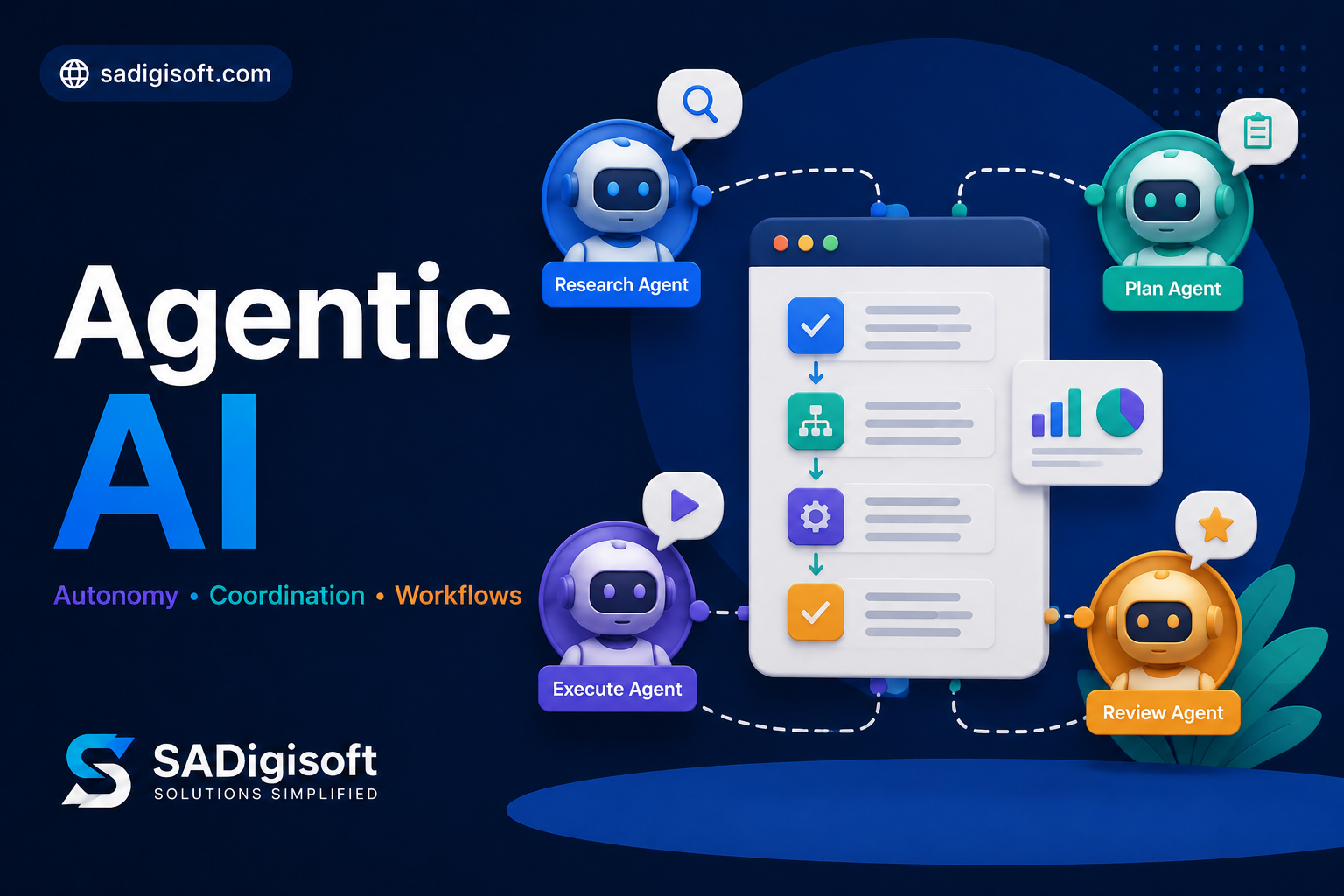
- Phase 4: Orchestrate multiple specialized agents into end-to-end automated workflows
Conclusion
The agentic shift is not a distant future — it is actively underway. Organizations that invest now in developing internal AI agent capabilities, building the requisite data infrastructure, and developing human-AI collaboration skills will compound those advantages into significant competitive moats. Those who wait may find the automation gap insurmountable within three to five years.
Sources & Further Reading:
Google Search Central Documentation ·
Moz SEO Blog ·
Search Engine Land
Turn this article into a practical action plan
If this topic affects your site, campaign, or LMS growth path, we can help translate it into changes that actually fit your current setup.
Discuss This TopicFollow the related journey
Use the article as one step, then move into the service, portfolio, or broader blog context around it.