

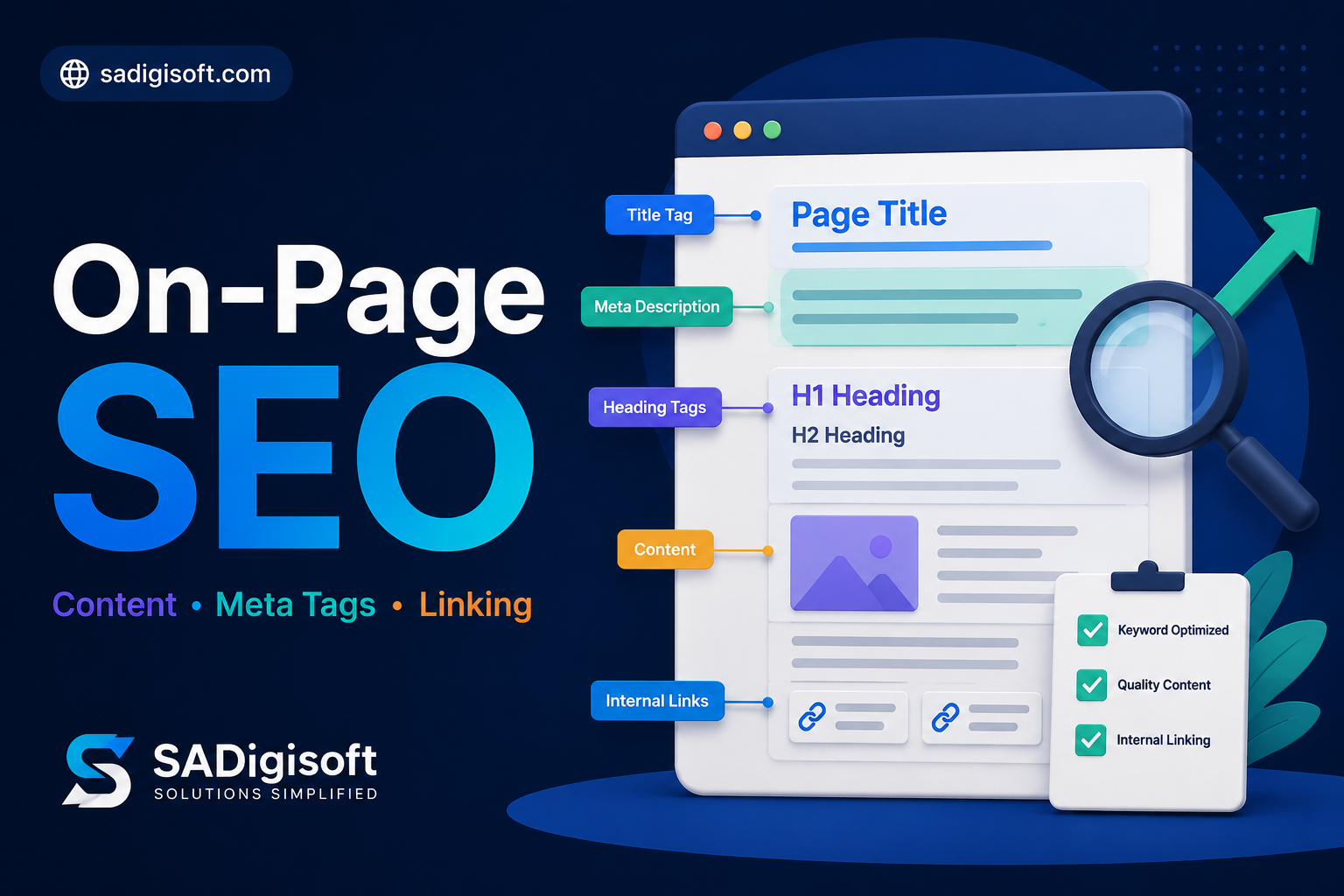
On-page SEO is the work done on a page itself to help search engines understand its purpose and help visitors complete the task they came for. It covers content, headings, titles, meta descriptions, image text, internal links, page structure, and overall clarity.
Why On-Page SEO Matters
Search engines do not rank pages simply because a business offers a service. They rank pages that clearly explain the topic, match user intent, and provide a good experience. If a service page is vague, thin, or poorly structured, even a strong design may not perform well in search.
For businesses, on-page SEO does two jobs at once. First, it improves discoverability. Second, it improves conversion by making the page easier to scan, understand, and trust.
The Main Elements of On-Page SEO
Page Title and Meta Description
The title tag helps search engines and users understand the page topic. The meta description supports click-through by setting expectations before the visit.
Heading Structure
A strong page normally has one clear H1, supported by H2 and H3 sections. This improves readability and helps search engines interpret the content hierarchy.
Useful, Intent-Matched Content
Good content answers the question behind the search. A page about SEO services should explain what is included, who it is for, what problems it solves, and what outcomes a business can expect.
Internal Links
Internal linking helps users discover related information and helps search engines understand which pages support each other. It is one of the simplest ways to strengthen topical depth across a site.
Images, URLs, and Accessibility Signals
Descriptive image alt text, readable URLs, and accessible page structure all contribute to a clearer website. These are often overlooked, but they support both usability and SEO.
Common Problems Seen on Business Websites
- Generic titles such as "Home" or "Services"
- Pages with very little original content
- Missing or duplicated meta descriptions
- No internal links to key service pages
- Headings used for styling instead of structure
- Pages that describe the company but not the customer problem
What Good On-Page SEO Looks Like in Practice
A strong page usually makes its purpose obvious within a few seconds. The visitor can see what the page is about, who it is for, what value it offers, and where to go next. The same clarity helps search engines classify the page more confidently.
For example, a weak services page may say a company offers "complete digital solutions" without defining what that includes. A stronger page breaks the service into components, explains the workflow, answers common objections, and links to related proof such as case studies or supporting articles.
Why This Supports More Than Rankings
Well-structured pages also improve lead quality. Visitors who understand the offer before contacting a business tend to ask better questions and arrive with clearer expectations. That makes on-page SEO useful for both visibility and sales conversations.
A Simple Way to Review a Page
Ask four questions. What is this page about? Who is it for? What action should the visitor take next? Is the answer visible within the first few seconds? If any of those answers are unclear, the page likely needs on-page SEO improvement.
Final Thought
On-page SEO is not a trick and it is not separate from good marketing. It is the discipline of making each page clear, useful, and easy to understand. That is why it remains the starting point for nearly every sustainable SEO strategy.
Sources & Further Reading:
Google Search Central Documentation ·
Moz SEO Blog ·
Search Engine Land
Turn this article into a practical action plan
If this topic affects your site, campaign, or LMS growth path, we can help translate it into changes that actually fit your current setup.
Discuss This TopicFollow the related journey
Use the article as one step, then move into the service, portfolio, or broader blog context around it.