

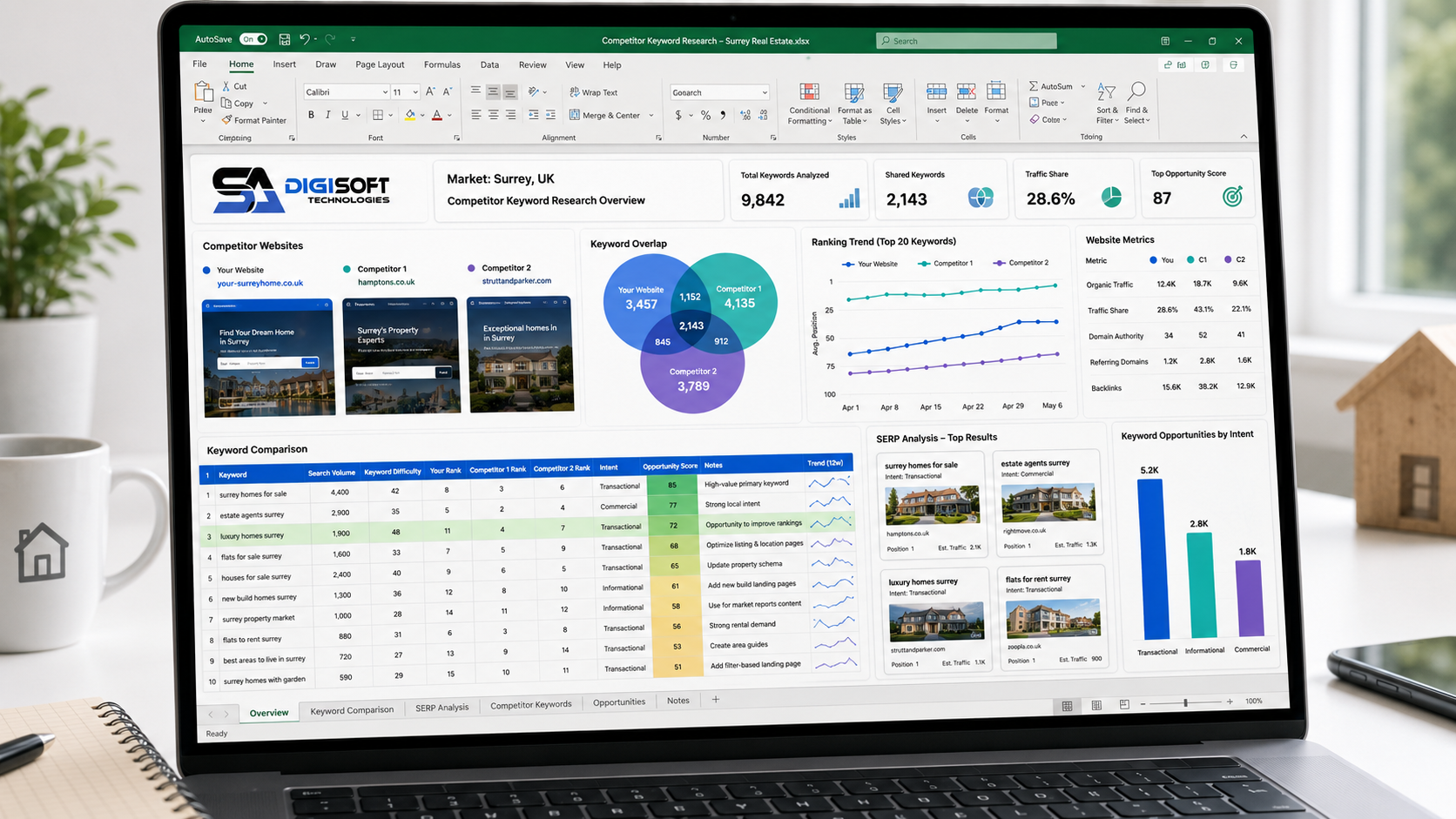
Competitor keyword research is useful, but it becomes dangerous when people treat exported keyword lists as strategy. Tools can show you where visibility exists. They cannot tell you, by themselves, why a page ranks, what kind of page should target the query, or whether that keyword is even worth your effort.
Start with pages, not domains
A competitor domain can rank for thousands of terms, but that does not mean the domain is your real competitor for each one. The smarter approach is to look at which specific pages rank for the search themes you care about. Are they program pages, guides, comparison articles, directories, or local landing pages? That tells you far more than the domain name alone.
What Semrush and Ubersuggest are good at
- Finding overlap - where a competitor ranks and you do not.
- Estimating demand - rough search-volume direction and related terms.
- Spotting clusters - groups of terms around one subject or commercial theme.
- Surfacing likely winners - the pages that appear to bring competitors meaningful visibility.
What these tools do not tell you
They do not tell you whether the search intent is informational, comparative, local, or transactional. They do not tell you whether Google currently prefers listicles, service pages, program pages, local results, or video results. They also do not tell you whether a competitor is ranking because of content quality, link authority, local signals, brand strength, or simply because nobody better has published yet.
How to read the data properly
Take a keyword from the tool, then inspect the search results manually. Ask what format Google is rewarding. If the top results are all guides, a service page may struggle. If local results dominate, then location signals matter. If comparison-style pages rank, the searcher is likely evaluating options rather than ready to buy immediately.
Look for gaps, not clones
The goal is not to copy a competitor article headline for headline. It is to notice what they have covered well, what they have covered thinly, and what they are ignoring. Sometimes the best opportunity is not the keyword they rank for best, but the adjacent question they have barely answered.
Where this fits into the content plan
Competitor keyword research should feed a larger map: which queries deserve service pages, which belong in blogs, which need local pages, and which should become FAQs or supporting resources. That is especially important in education SEO, where a single topic can have career intent, comparison intent, local intent, and enrolment intent all at once.
Final thought
Semrush and Ubersuggest are useful because they make the market easier to see. They become dangerous only when they replace judgment. Read the data, then read the pages, then read the search results. That order produces a far better strategy than exporting a spreadsheet and chasing volume.
Sources & Further Reading:
Google Search Central Documentation ·
Moz SEO Blog ·
Search Engine Land
Turn this article into a practical action plan
If this topic affects your site, campaign, or LMS growth path, we can help translate it into changes that actually fit your current setup.
Discuss This TopicFollow the related journey
Use the article as one step, then move into the service, portfolio, or broader blog context around it.