


Service at a glance
Google Business Profile | Citations | Reviews | Local Pages | Local Schema
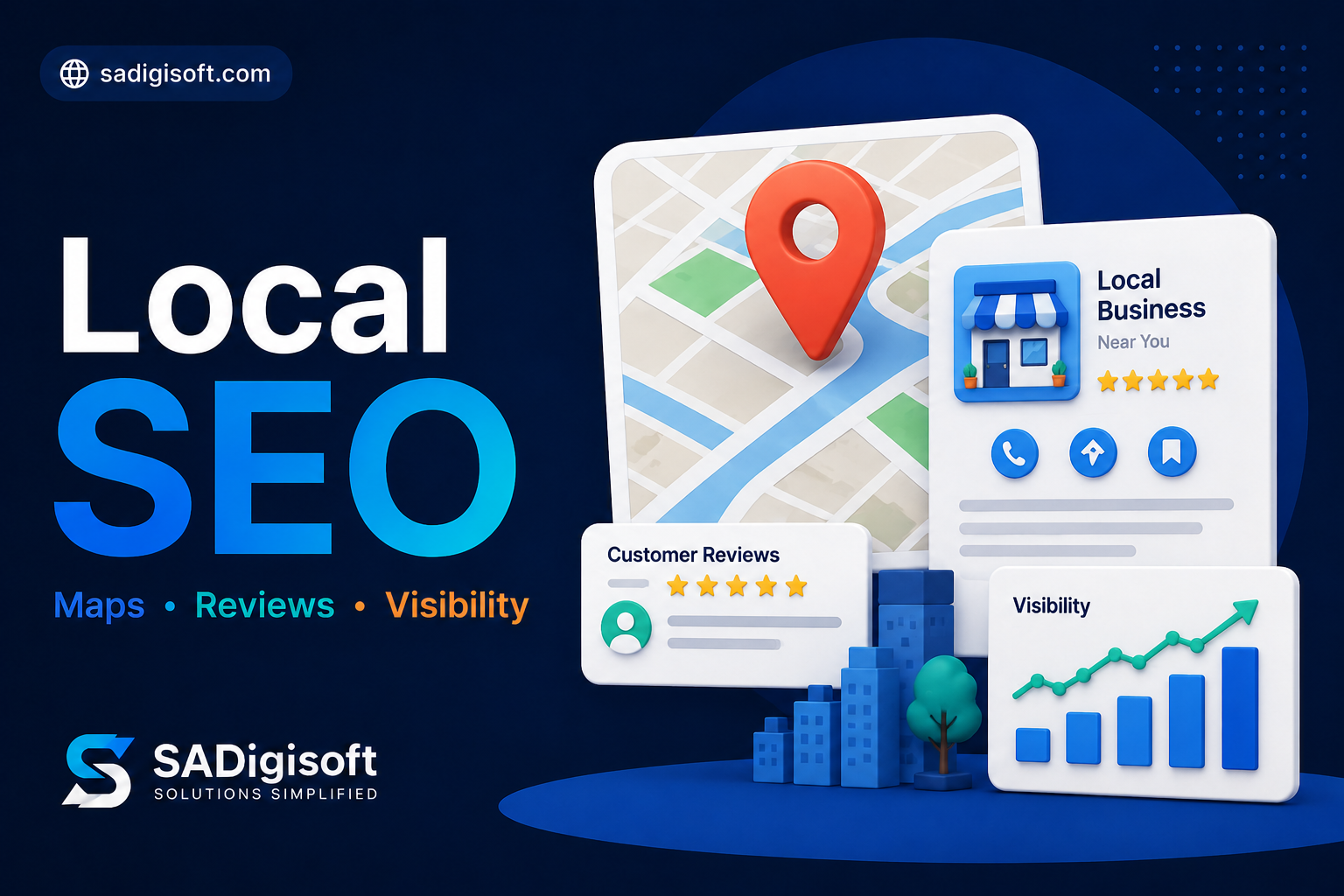
Local SEO is how a business that serves a place — a city, a region, a set of towns — gets found by the people searching there. When someone searches with local intent or "near me", Google shows a map pack and local results before anything else. Local SEO is the work that gets you into that pack and keeps you there.
Our local SEO process
- 1. Google Business Profile – We optimise the profile that drives the map pack: correct categories, services, attributes, photos, posts and Q&A, all kept accurate and complete.
- 2. NAP & citation consistency – We make sure your name, address and phone are identical across the directories and platforms Google cross-checks for trust.
- 3. Review strategy – A practical, policy-compliant approach to earning and responding to reviews, which strongly influence local ranking and conversion.
- 4. Local landing pages – Where you genuinely serve multiple areas, we build distinct, useful location pages — never thin, duplicated "doorway" pages that risk a penalty.
- 5. Local content & links – Locally relevant content and citations from community, industry and regional sources that reinforce where you operate.
- 6. Local schema – LocalBusiness structured data so search engines read your location, hours and service area correctly.
How we research local keywords
Local keyword research works differently from national research, and the difference costs businesses money. The terms that matter are usually low-volume — often reported as "0" by keyword tools — because they combine a service with a neighbourhood, suburb or town. That zero is misleading: it reflects the tool's sampling, not real demand, and those searches convert far better than the broad city term everyone competes for. We build the list from the areas you genuinely serve, cross-referenced against the queries already reaching you in Search Console and the questions you field on the phone. Tools in the Semrush and Ubersuggest family size the organic terms sitting beneath the pack, but we never let a tool's volume estimate veto a term we know customers use.
How we read local competitors
Your ranking is not a single position — it changes with the searcher's location, which is why checking from your own office tells you almost nothing. A business can lead the pack from its own postcode and be invisible two miles away. We check results from the areas you actually care about, using local rank-tracking tools such as BrightLocal or the local modules in the Semrush family, which sample rankings across a geographic grid and show you the real shape of your visibility. Then we diagnose why a competitor holds the pack: primary category choice, review count and recency, proximity, profile completeness, citation consistency. The answer is frequently mundane and fixable — a better-chosen primary category, or a competitor who simply asks every customer for a review. These are signals no keyword tool reports, which is exactly why local SEO is so often mis-sold as a content problem.
The tools, and what they are actually for
Google Business Profile itself is the primary source — its insights show what people searched to find you and what they did next. Search Console covers the organic side, BrightLocal or Whitespark handle citation auditing and grid-based rank tracking, and Semrush or Ubersuggest cover the surrounding keyword landscape. Tools find the discrepancies; deciding which ones matter is judgement. No local SEO tool will tell you that your primary category is wrong.
How we keep it credible
Local SEO invites shortcuts — fake addresses, spun city pages, incentivised reviews — that Google penalises hard. We only build local signals you can genuinely stand behind. If you serve an area, we help you rank there honestly; we will not invent a presence you do not have.
What you receive
- A fully optimised, accurate Google Business Profile.
- A citation audit and consistency clean-up across key directories.
- A review-generation and response plan that stays within platform rules.
- Genuinely distinct local landing pages where they are warranted.
- Local ranking and map-pack visibility tracking over time.
Where local SEO fits
Local signals sit on top of solid technical and on-page SEO, and citation work overlaps with off-page SEO. For education clients, local SEO is powerful for physical training centres and campuses — see SEO for education & eLearning. Start from the SEO overview.
Not showing up in the local map pack where you should be? Ask us for a local SEO review.
How We Deliver
Discovery
We review the current site, search visibility, target audience, and the highest-priority pages first.
Audit & Prioritise
We identify the technical, on-page, off-page, and local issues that deserve attention first.
Implement
We improve key pages, fix technical blockers, strengthen internal structure, and support authority-building actions.
Measure & Improve
We track movement, report on findings, and refine the next set of marketing priorities based on real performance.
Related Resources
Need help choosing the right digital marketing scope for your website?
Connect with us to discuss technical SEO, on-page priorities, content, campaigns, local search goals, analytics, and the right package structure for your business.
Contact Us About Digital Marketing