

Education SEO starts with understanding how learners search. A future student does not search the same way a B2B software buyer does. They ask career questions, compare pathways, look for proof, evaluate price and schedule, and often search locally before they commit. Good keyword research captures that whole journey rather than chasing one obvious phrase.
Start with the education journey, not a tool export
Before opening any SEO platform, list the questions a learner asks from first curiosity to final enrolment. A typical journey might begin with "how to become a medical assistant", move to "medical assistant certification online", then narrow to "medical assistant classes near me" or "best medical assistant program in Texas". Those are different intents and should not be forced onto the same page.
The main keyword groups education brands need
- Discovery queries — broad questions about careers, subjects, qualifications, and outcomes.
- Comparison queries — searches such as "best", "top", "vs", "review", and "worth it".
- Program-intent queries — specific course, diploma, bootcamp, or certification terms.
- Local-intent queries — "near me", city, state, and campus-based searches.
- Support queries — fees, duration, eligibility, job prospects, curriculum, and online-vs-offline questions.
How to separate blog topics from money pages
One of the most common education SEO mistakes is pushing every keyword onto a course page. Informational searches usually belong in blogs, guides, FAQs, and resource hubs. High-intent enrolment searches belong on program, campus, or course pages. This separation matters because it keeps content focused and reduces cannibalisation.
How to read competitor keywords properly
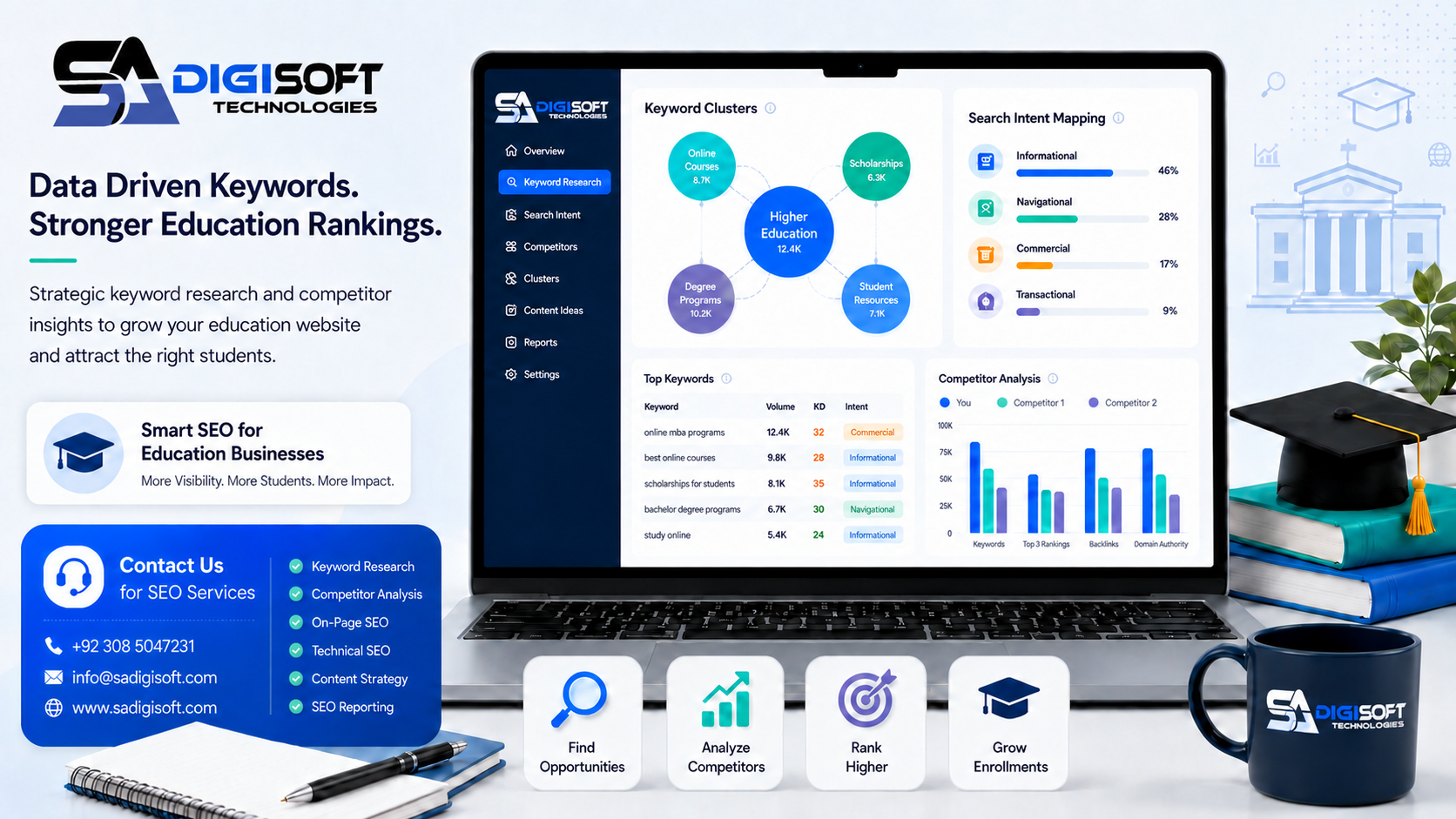
Competitor research is more useful when you study pages, not just domains. Look at which page ranks for a keyword, what angle it takes, how detailed it is, which FAQs it includes, and what internal links support it. A competitor may rank because they built a complete topic cluster around a course, not because they mentioned the keyword more times.
When we review competitors, we usually ask:
- Which program and blog pages attract the most relevant traffic?
- Which questions are they answering well?
- What intent are they missing or handling weakly?
- Are they strong because of content depth, site authority, local presence, or all three?
Where Semrush, Ubersuggest and Yoast SEO fit
Semrush and Ubersuggest are useful for estimating search demand, related terms, keyword overlap, and competitor visibility patterns. They help create a shortlist, but they do not replace judgment. Search volume alone does not tell you whether a term belongs on a blog, a category page, a course page, or a campus page.
Yoast SEO plays a different role. It is not primarily a research tool; it is an implementation aid for WordPress sites. It helps teams improve titles, meta descriptions, readability, schema support, and editorial discipline once the content plan already exists.
Why manual SERP review still matters
Always look at the actual search results. If Google shows list articles, the intent is probably comparative or informational. If it shows local packs, local SEO matters. If it shows program pages, the query may be closer to enrolment. SERP review keeps you from building the wrong page for the right keyword.
How AEO changes keyword research
Education brands now need to think beyond traditional rankings. Learners increasingly ask AI tools direct questions, which means answer-shaped content matters more. That is where AEO enters the strategy. Clear questions, direct answers, clean structure, and corroborating content help your site become easier for AI systems to cite.
What a practical content map looks like
A healthy education SEO plan normally includes strong program pages, local landing pages for physical campuses, comparison-style content, question-led blog posts, and a technical foundation that makes all of those assets crawlable and easy to interpret. This is why keyword research should connect directly to technical SEO, on-page SEO, and off-page authority rather than living in a spreadsheet alone.
Final thought
Good keyword research for education SEO is really market reading. It helps you understand what learners want, how competitors frame their pages, which topics deserve a course page, and which questions should become content assets. When done well, it gives the whole site a structure that feels helpful to both users and search engines.
Sources & Further Reading:
Google Search Central Documentation ·
Moz SEO Blog ·
Search Engine Land
Turn this article into a practical action plan
If this topic affects your site, campaign, or LMS growth path, we can help translate it into changes that actually fit your current setup.
Discuss This TopicFollow the related journey
Use the article as one step, then move into the service, portfolio, or broader blog context around it.