

A course platform is not a normal website. It can have hundreds or thousands of course, category, instructor and tag pages, filters that multiply URLs, and a search box that generates endless thin pages. Left unmanaged, this quietly buries the pages you actually want to rank. Technical SEO for course platforms is largely about control: telling search engines what matters and stopping them wasting effort on what does not.
Why course catalogues break generic SEO advice
Most SEO guidance assumes a modest number of pages. Learning platforms break that assumption. Every filter combination, sort order and paginated view can create another URL, and search engines have a limited crawl budget for your site. If that budget is spent crawling near-duplicate filter pages, your important course pages get crawled and updated less often.
The technical issues that matter most
Faceted navigation and filters
Filters for level, price, duration or topic are useful for learners but dangerous for crawlers. Decide which filtered views deserve to be indexable (because people search for them) and which should be blocked or canonicalised. A "beginner Python course" filter might be worth ranking; a "sorted by newest, page 7" view is not.
Pagination and infinite scroll
Long catalogues need pagination search engines can follow. Infinite scroll that never exposes real URLs can hide most of your courses from Google entirely. Ensure paginated pages have crawlable links and that deep courses are reachable within a few clicks of the homepage.
Crawl budget and index bloat
Use robots directives, canonical tags and internal linking to concentrate crawling on real course and category pages. Keep search-results pages, session URLs and tracking parameters out of the index.
Course structured data
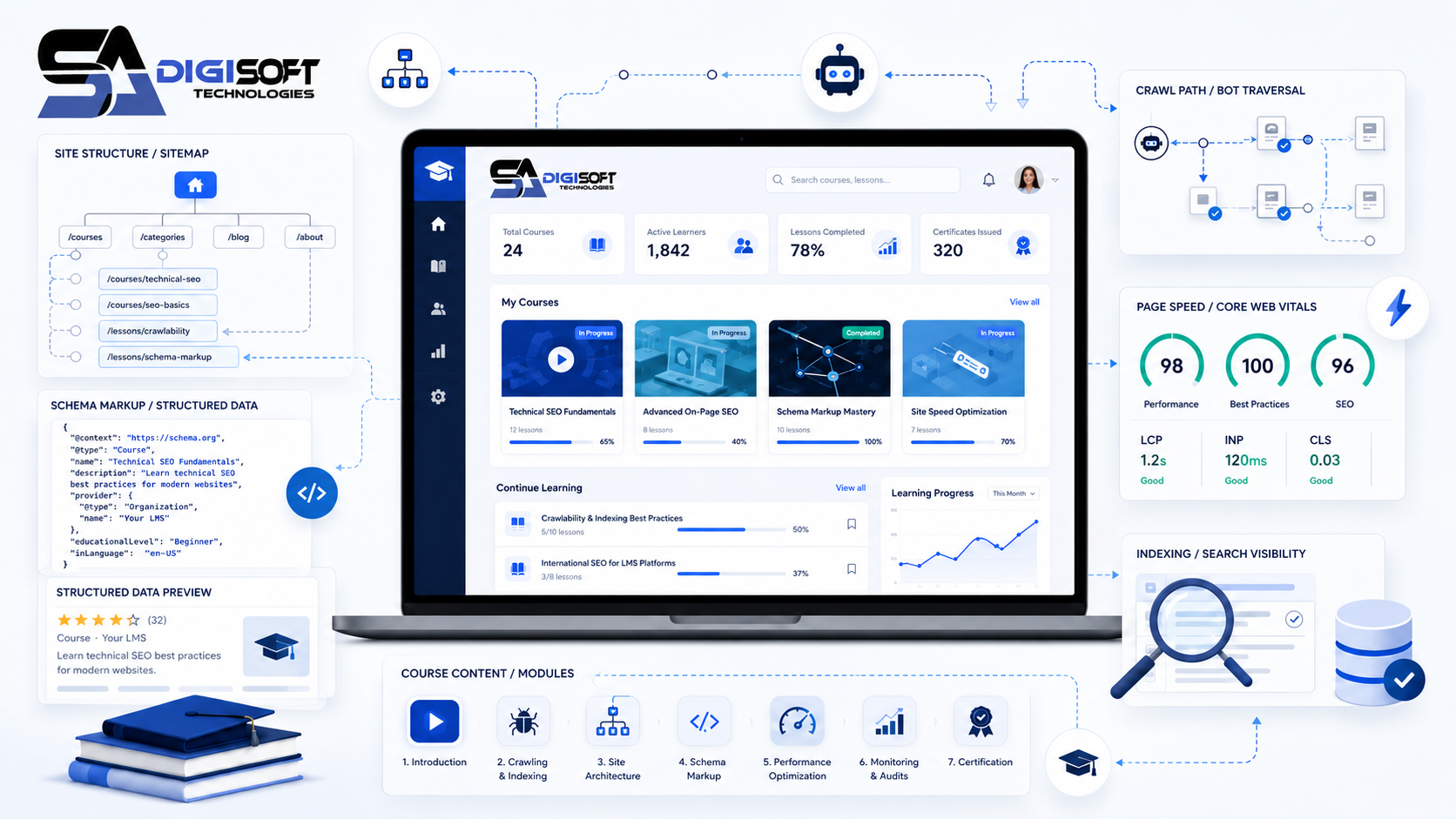
Implement Course schema so search engines and AI answer engines understand each course — its name, provider, and description. This is one of the few schema types purpose-built for education, and most competitors ignore it.
Speed at scale
Course pages often carry heavy media — video previews, images, embedded players. Core Web Vitals still apply. Lazy-load media, serve appropriately sized images, and keep the main course content fast to render, because a slow catalogue frustrates both learners and rankings.
How this connects to the platform itself
The cleanest fix for many of these problems is at the platform level, not bolted on afterwards. Because we build learning platforms as well as optimise them, we can address catalogue structure, URL design and schema at the source. See our technical SEO service, the education-focused SEO for education & eLearning, and LMS development.
Final thought
For a course platform, technical SEO is mostly about discipline: index the pages that earn enrolments, suppress the noise, and describe your courses in a language machines understand. Get that right and every other SEO effort works harder.
Sources & Further Reading:
Google Search Central Documentation ·
Moz SEO Blog ·
Search Engine Land
Turn this article into a practical action plan
If this topic affects your site, campaign, or LMS growth path, we can help translate it into changes that actually fit your current setup.
Discuss This TopicFollow the related journey
Use the article as one step, then move into the service, portfolio, or broader blog context around it.